



647-568-0258
AP Statistics
$999.00
All course prices are in CAD – Canadian Dollars
Course Description For AP Statistics
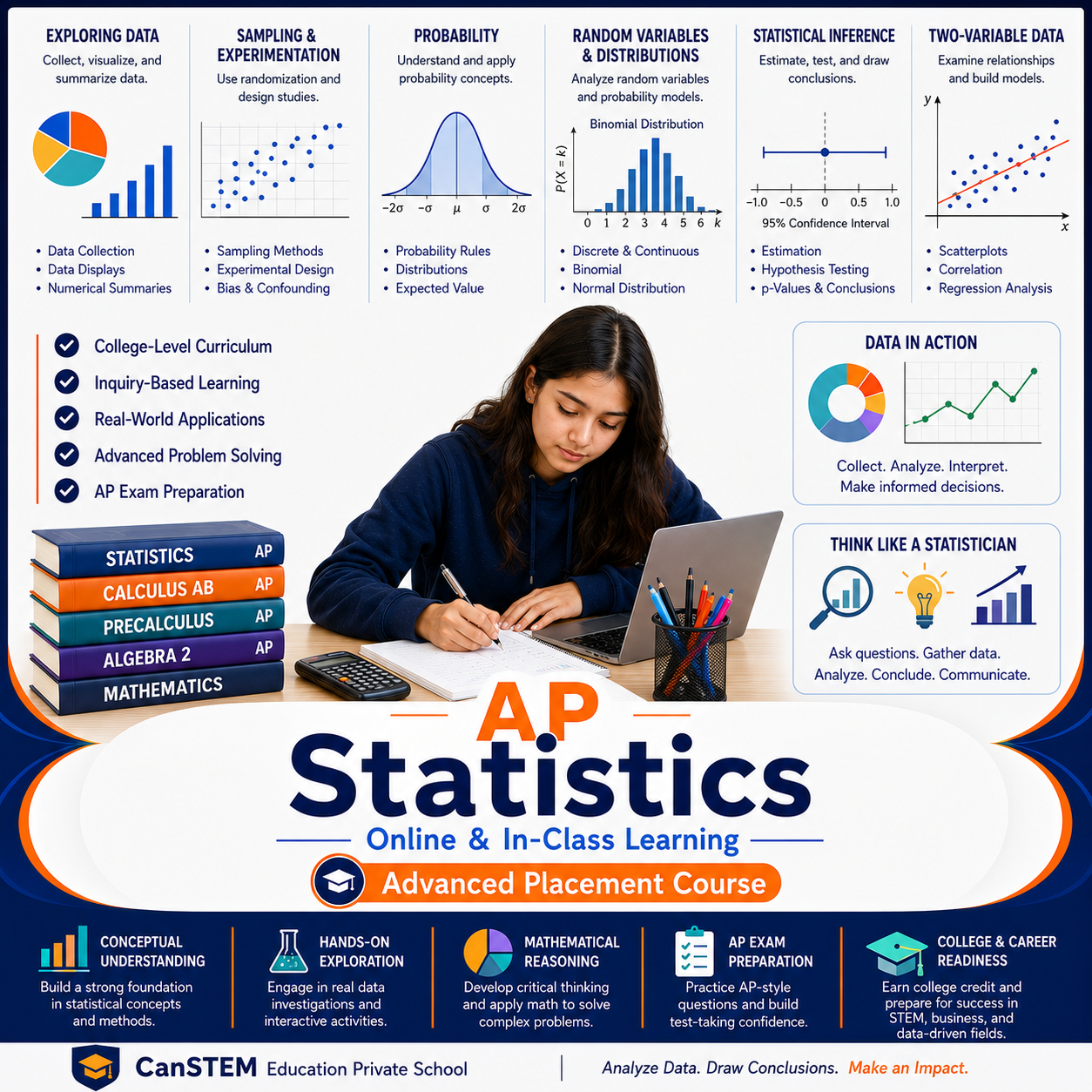
AP Statistics is a college-level Advanced Placement course that introduces students to collecting, analyzing, interpreting, and drawing conclusions from data. First, students study descriptive statistics, probability, sampling, experimental design, statistical inference, and regression. Next, they learn to analyze data, evaluate evidence, and communicate statistical conclusions clearly. In addition, students strengthen their statistical reasoning, critical-thinking, and problem-solving skills through real-world applications. As a result, they prepare for the AP Statistics Exam and build a strong foundation for future studies in mathematics, business, economics, social sciences, health sciences, and other data-driven fields.
Skills You'll Learn
Course Content
| Unit | Title | Expectations Summary | Focus |
|---|---|---|---|
| 1 | Exploring One-Variable Data and Collecting Data | First, students describe distributions, compare center and variability, and identify unusual features. In addition, they examine sampling methods, experimental design, bias, randomization, and data collection. | Data Collection |
| 2 | Probability, Random Variables, and Probability Distributions | Next, students use simulation and probability rules to model uncertainty. Moreover, they analyze discrete random variables, binomial distributions, and normal distributions. | Probability |
| 3 | Inference for Categorical Data: Proportions | Students construct and interpret confidence intervals for proportions. Then, they perform significance tests, verify conditions, and explain conclusions in context. | Proportions |
| 4 | Inference for Quantitative Data: Means | Students analyze sampling distributions for means and construct confidence intervals. In addition, they conduct t-tests, check conditions, and interpret statistical evidence. | Means |
| 5 | Regression Analysis | Students investigate scatterplots, correlation, least-squares regression, residuals, transformations, and inference for slope. Furthermore, they interpret regression models in context. | Regression |
| Final | AP Statistics Review and Investigation Portfolio | Finally, students complete AP-style cumulative practice and a statistical investigation portfolio. As a result, they strengthen their skills in question formulation, data collection, analysis, and interpretation. | AP Preparation |
Frequently Asked Questions
AP Statistics is a college-level course that teaches students how to collect, analyze, interpret, and draw conclusions from data. It prepares students for the AP Statistics Exam and college-level statistics.
AP Statistics is ideal for students interested in mathematics, business, economics, health sciences, social sciences, and other data-driven fields. It is also a great choice for students who enjoy problem-solving and working with data.
Students develop skills in data analysis, probability, statistical reasoning, and interpreting real-world data. They also learn to communicate conclusions using graphs, tables, and statistical models.
Students are recommended to have completed a first-year algebra course before taking AP Statistics. Calculus is not required.
AP Statistics is typically completed over one academic year. It prepares students for the AP Statistics Exam and future college-level coursework.
Address
Contact us
647-568-0258: Customer Service
647-847-1231: Student Support
647-335-1660: Teacher Helpline
647-709-0258: Admin/Guidance
905-454-6744: Front Office
© 2026 CanSTEM Education Inc. All Rights Reserved.
Land Acknowledgement →
Privacy Policy
Terms & Conditions
Accessibility
Sitemap
Land Acknowledgement
The City of Brampton is located on the traditional territories of the Mississaugas of the Credit, Haudenosaunee and Wendat Nations who have called this land home since time immemorial.
We recognize the Mississaugas of the Credit as the original rights holders and the signatories of Treaty 19—the Ajetance Purchase of 1818—and that the agreements made therein are foundational to our nation-to-nation relationship.
As a City, we are committed to our ongoing role in reconciliation through meaningful action rooted in truth, justice and respect.
We are grateful to the original caretakers of this land who have ensured we are able to work, play and live in Brampton now and in the future.
Close