



647-568-0258
AP Art History
$999.00
All course prices are in CAD – Canadian Dollars
Course Description For AP Art History
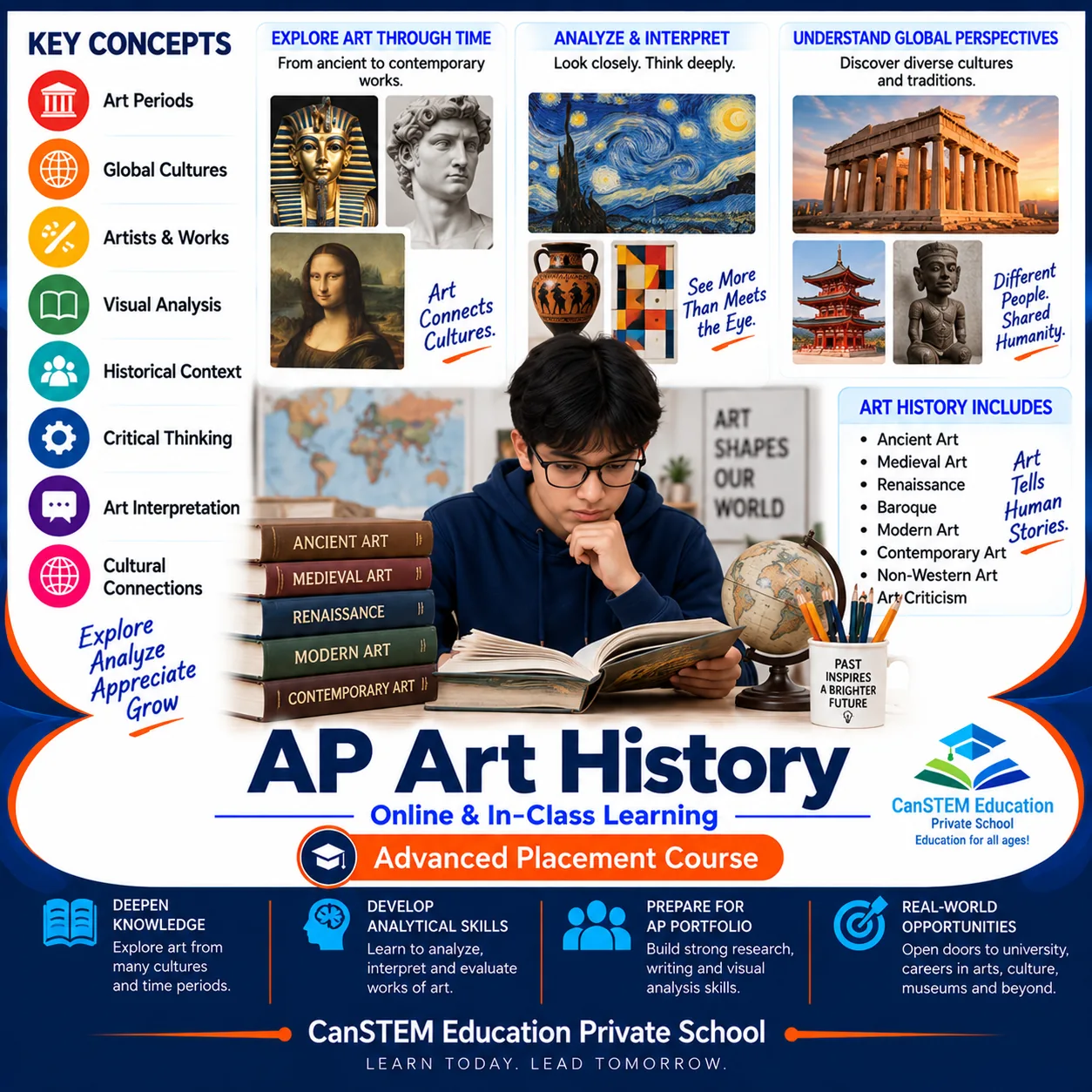
AP Art History is a college-level Advanced Placement course that explores art from different cultures, regions, and historical periods. First, students study major works of art, architecture, and visual traditions. In addition, they learn how history, culture, religion, and society influence artistic meaning. Students also develop skills in visual analysis, comparison, interpretation, and research. For example, they compare artworks and use evidence to explain their purpose, style, and cultural importance. As a result, students build stronger analytical and critical-thinking skills. Overall, the course prepares students for the AP Art History Exam and future studies in art, history, architecture, humanities, and related fields.
Skills You'll Learn
Course Content
| Unit | Title | Expectations Summary | Focus |
|---|---|---|---|
| 1 | Global Prehistory | First, students examine prehistoric works from 30,000–500 BCE. They study how materials, environment, ritual, belief, and social life shaped early art and architecture. | Origins of Art |
| 2 | Ancient Mediterranean | Next, students analyze art and architecture from 3500 BCE–300 CE. In addition, they explore works from Egypt, Greece, Rome, and nearby cultures with attention to power, religion, function, and artistic tradition. | Ancient Civilizations |
| 3 | Early Europe and Colonial Americas | Students then study works from 200–1750 CE. They also explore how religion, patronage, cultural exchange, political authority, and artistic traditions shaped European and colonial art. | Faith and Exchange |
| 4 | Later Europe and Americas | Afterward, students investigate art from 1750–1980 CE. They examine changes in society, technology, politics, identity, modernity, and artistic practice across Europe and the Americas. | Modern Art |
| 5 | Indigenous Americas | In addition, students explore Indigenous art from 1000 BCE–1980 CE. They consider how community, spirituality, environment, materials, identity, and cultural continuity shape artistic meaning. | Indigenous Traditions |
Global Traditions and Contemporary Art
| Unit | Title | Expectations Summary | Focus |
|---|---|---|---|
| 6 | Africa | Similarly, students study African works from 1100–1980 CE. They analyze how art communicates political authority, spirituality, ancestry, social identity, performance, and community values. | African Traditions |
| 7 | West and Central Asia | Meanwhile, students examine works from 500 BCE–1980 CE. They investigate the roles of religion, empire, trade, cultural exchange, architecture, ornament, materials, and artistic practice. | Art and Exchange |
| 8 | South, East, and Southeast Asia | Students also analyze works from 300 BCE–1980 CE. In addition, they explore connections among religion, philosophy, court culture, landscape, ritual, technology, and regional artistic traditions. | Asian Art |
| 9 | The Pacific | Next, students study Pacific art from 700–1980 CE. They examine how works communicate ancestry, spirituality, social status, navigation, environment, ceremony, and community identity. | Pacific Traditions |
| 10 | Global Contemporary | Finally, students investigate global art from 1980 CE to the present. They analyze how artists address identity, politics, migration, technology, globalization, social issues, and cultural change. | Contemporary Art |
| Skills | Art Historical Thinking Skills | Throughout the course, students practise visual analysis, contextual analysis, comparison, artistic traditions, analysis of unknown works, attribution, interpretation, and evidence-based argumentation. | AP Skill Development |
| Resources | Primary, Secondary, and Museum Sources | In addition, students use the required image set, a college-level art history text, primary sources, scholarly secondary sources, and selected museum resources to support research and interpretation. | Research and Evidence |
Frequently Asked Questions
AP Art History is a college-level Advanced Placement course that explores art from different cultures, regions, and historical periods. Students study major works of art and architecture while learning how visual features, cultural context, and historical events shape meaning.
This course is ideal for students interested in art, history, architecture, culture, museums, or the humanities. In addition, it is a good choice for students who enjoy analyzing images, comparing ideas, and learning about different societies through art.
Students develop skills in visual analysis, contextual analysis, comparison, interpretation, and evidence-based argument. As a result, they learn to connect artworks with historical, cultural, political, and social contexts.
No specific prerequisite is required. Students with an interest in art, history, culture, and visual analysis are well suited for the course.
AP Art History is typically completed over one academic year. Throughout the course, students study required works, complete AP-style activities, and prepare for the AP Art History Exam.
Address
Contact us
647-568-0258: Customer Service
647-847-1231: Student Support
647-335-1660: Teacher Helpline
647-709-0258: Admin/Guidance
905-454-6744: Front Office
© 2026 CanSTEM Education Inc. All Rights Reserved.
Land Acknowledgement →
Privacy Policy
Terms & Conditions
Accessibility
Sitemap
Land Acknowledgement
The City of Brampton is located on the traditional territories of the Mississaugas of the Credit, Haudenosaunee and Wendat Nations who have called this land home since time immemorial.
We recognize the Mississaugas of the Credit as the original rights holders and the signatories of Treaty 19—the Ajetance Purchase of 1818—and that the agreements made therein are foundational to our nation-to-nation relationship.
As a City, we are committed to our ongoing role in reconciliation through meaningful action rooted in truth, justice and respect.
We are grateful to the original caretakers of this land who have ensured we are able to work, play and live in Brampton now and in the future.
Close